


Balin And The Hollow Knight - A Review

Open Shelf recently read Balin And The Hollow Knight by Larry Pearson. Here's our review.
Balin And The Hollow Knight is available HERE.
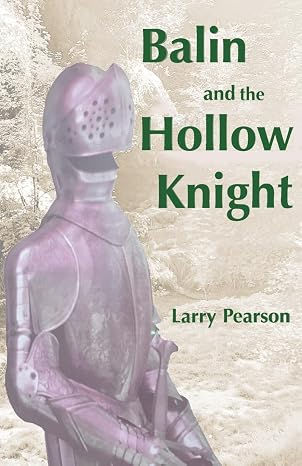
There is a particular pleasure in discovering a story that feels instantly timeless, as though it has always existed somewhere on a shelf between Diana Wynne Jones and Eva Ibbotson.
Readers will immediately recognise a kinship with the work of Diana Wynne Jones, whose novels often balanced humour, melancholy, and a wonderfully skewed sense of magical logic. Like Jones, this story presents a world where spells are powerful yet delightfully unreliable, and where characters navigate those misfires with wry resilience. Balin’s fading magic, Joey’s frog‑prince indignation, and Gregory’s earnest practicality echo the kind of character interplay Jones excelled at: funny without frivolity, emotionally grounded without losing their whimsy. The dry, observational humour feels particularly reminiscent of Jones’s ability to make the absurd feel both natural and inevitable. It is not imitation, but a shared tradition: a gently satirical, deeply humane style of fantasy that Jones helped define.
The comparison to Eva Ibbotson is equally apt, for these early chapters carry the same warmth, charm, and fairy‑tale gentleness that characterised her most beloved works. Ibbotson’s stories were known for their kindness, their whimsical worlds, and their affection for magical oddities, all qualities that appear here in abundance. The villagers’ gossip, the oak‑tree home, the blacksmith’s reluctant generosity, and Joey’s small emotional moments evoke the same cosy yet spirited atmosphere found in The Secret of Platform 13 or Island of the Aunts. The humour arises naturally from character rather than punchline, and even moments of danger are softened by a storyteller’s reassuring tone. Like Ibbotson, the author crafts fantasy that is accessible without being simplistic, emotionally resonant without being heavy, and filled with small, delightful absurdities that make the world feel enchantingly alive.
Let’s get back to this story. The opening chapters of this tale introduce us to Balin, the oldest wizard in the world, whose magic is fading in ways both comic and poignant. What follows is a gently humorous, beautifully voiced fantasy that already shows the hallmarks of a classic.
From the first page, the narrative voice stands out. It has the confidence and warmth of a seasoned storyteller, the kind who leans forward by the fire and knows exactly when to wink at the reader. The humour is soft and observational such as Becky losing her washing to the river, the king’s crown rolling away, the unfortunate peddler cursed with an elephant’s trunk, yet beneath the whimsy lies a steady emotional pulse. The tone never falters; it’s consistent, inviting, and effortlessly readable.
The characters are drawn with the same deft touch. Balin himself is a delight: dignified, weary, and quietly proud, a wizard whose misfiring magic is treated not as tragedy but as a gentle sadness. Joey, the frog prince, is both comic relief and emotional anchor, his wide mouth drooping at the sight of armour he once wore with pride. Gregory, the blacksmith’s apprentice, brings youthful curiosity and earnestness to the trio, grounding the story with his simple observations and unshakeable belief in possibility.
Even minor characters, such as Becky, the blacksmith, the king, appear briefly yet memorably, sketched with quick strokes that make them feel alive. The world they inhabit is equally charming: a kingdom with only one clock, a wizard living in a giant oak, villagers who fear magic precisely because it is unpredictable. The magical details that give us whiffle dust, moonbeams, carrot scrapings, dew, give the story a playful internal logic that feels both whimsical and coherent.
Plotwise, this moves with admirable clarity. The story begins with small personal stakes, expands to royal ones, then settles into the emotional heart of Balin’s decline before pivoting toward adventure. The creation of Sir David, the magical knight, is a highlight. It’s inventive, funny, and full of promise. It marks the moment when Balin’s fading magic meets the ingenuity of his unlikely companions, and the narrative shifts from melancholy to momentum.
Themes of aging, friendship, and the quiet dignity of trying, even when one’s best days seem behind them, run gently through these chapters. Yet the tone remains light, never heavy. This is a story that would read aloud beautifully, full of charm, humour, and emotional resonance.
What stands out most strongly is the author’s command of narrative voice. The prose moves with an effortless clarity, balancing humour, melancholy, and worldbuilding without ever feeling laboured. Sentences are shaped with a storyteller’s instinct: long, winding observations give way to crisp comedic beats, and moments of quiet emotion are allowed to breathe. The humour is never forced; it arises naturally from character and situation, demonstrating a fine understanding of timing. Even the smallest details, a kingfisher’s dive, a loaf of bread half‑eaten by a blacksmith, a frog reluctantly making a nest, are rendered with a gentle precision that makes the world feel both whimsical and real. It is the kind of craft that looks simple on the surface but is, in truth, the product of careful control and a deep feel for rhythm.
Equally impressive is the structural craft at work. The author manages a subtle escalation of stakes: beginning with domestic mishaps, moving through royal requests, and arriving at the creation of a magical knight and the promise of adventure. This progression is handled with remarkable grace. Each chapter feels self‑contained yet contributes to a larger arc, and the emotional through‑line, Balin’s fading magic and the quiet hope of renewal, is woven with consistency and restraint. Characterisation is achieved through action rather than exposition, and dialogue carries both personality and purpose. The pacing is confident, shifting from cosy scenes to atmospheric tension without losing tonal coherence. It is clear from the start that the author understands how to build a world, guide a reader, and shape a narrative that feels both classic and fresh.
Overall, this is a light fun take on the fantasy genre. There are no deep scheming or epic encounters, rather it is a close look at people that is told with a tongue in the cheek. The main players are people you would happily go on a quest with, whether it was to tackle a clutch of dragons or to work out how to draw water from a well when you don’t have a bucket. Having read a lot of high and epic fantasy, this is a refreshing version showing what is truly important in a story.
You can find Balin And The Hollow Knight HERE.
Find more titles on our Books page HERE.


Comments