


Andrea C Knapp - An Interview

Bale Fyre is a tale of witches, vampires and revenge, based in the modern day but with deep roots in the long past.
Open Shelf caught up with author Andrea C Knapp to find out more.

Bale Fyre opens with a striking ritual scene in 1711. What inspired you to begin the story with a moment of myth and danger rather than exposition?
Beginnings are hard. I wanted to open with something that would grab attention, pull readers into the atmosphere, and set the stakes immediately, and I didn’t want to bog that down with too much explanation right away.
It is a rich start, straight into the action of the past. The world blends folklore, elemental magic, and modern settings. How did you approach building a mythology that feels both ancient and immediate?
I did a lot of research leading up to the actual writing because I wanted to stay as true to the mythology and history as possible and to make it feel immersive, like it was woven into everything. And then I decided to tell the story in the nonlinear way of blending flashbacks with present-day events to connect it all and make the past feel like a part of the present instead of the two time periods feeling like two separate stories.
The term “bale fyre” carries a lot of symbolic weight. When did you know it would become the title?
The book was untitled until probably 80% of the way in. I kept batting around ideas, and nothing felt right. When I was doing research for a name for one of the spells, I came across the word “balefire.” One of the older definitions is a funeral pyre or a sacred or fatal fire. I couldn’t get the word out of my head after that, not just for the spell but because it felt so fitting for Kenna’s magic and the overall role of fire. It was the first thing that “clicked” for me in terms of a title.
With a story steeped in old magic, how did you balance the darker, atmospheric elements with the emotional intimacy of the story?
I feel like a lot of the emotions and trauma the characters deal with are heavy, so they already fit with the darker tone of the story, which made it easy for the emotion and the atmosphere to work with rather than against each other.
Moving onto the characters, Draven is a morally grey antagonist with centuries of history behind him. What makes him compelling for you as a writer?
I love a multilayered “villain” because most of the time, something happens to make him the villain, and there’s usually still some humanity left in there somewhere. So for Draven, it was getting to explore what humanizes him and what brings his walls down. He was inspired by Klaus Mikaelson from The Vampire Diaries and The Originals because I was so drawn to that character, this man who comes across as a monster but has a soft spot for the people he loves and values things like loyalty and honesty. That duality of character is so fun to explore and put my own spin on.
Kenna’s journey is part coming‑of‑age, part awakening. What aspects of her character were most important for you to get right?
I didn’t want her to ever appear weak or like a damsel in distress. But I also wanted her to be likeable despite her sarcasm, impulsivity, and sometimes downright crassness. So I really wanted to show her layers and make sure readers understand where she’s coming from and why she makes the decisions she does.
The dynamic between Kenna and Draven is tense, layered, and often unsettling. How did you navigate writing an enemies‑to‑lovers arc without losing the danger?
It was hard sometimes because there were moments I wanted them to have the beautiful relationship they both deserve, but that isn’t right for either of their characters at this point in time. They’re in this fraught situation with high stakes, and despite her feelings for Draven, Kenna still feels like she has no choice but to kill him. And Draven is dealing with his own conflicts that get in the way of his feelings. So I had to keep that in mind the whole time and kind-of put myself in that place of how that would feel and how those conflicts would play out.
The cast is compact but memorable. Did any character surprise you as the story developed?
I would say probably Tara. I wasn’t quite sure how her story would go at first aside from the fact that I really wanted to include a banshee. But I wanted to do something a little different besides what you see in movies and shows. I wanted to lean into the mythology of the banshee but also create this character who felt human. So as I started writing her, she emerged as this reluctant death omen who still has human traits and wants, which feels different from the way I’ve seen the banshee portrayed. And it gives her some depth instead of her just being there.
The characters are a real feature of the story and it is interesting to see such a compact cast explored. Looking at the broader story, it deals with legacy, trauma, and the weight of generational conflict. What themes were you most interested in exploring?
The idea that things are not always black and white, and there’s not always a clear-cut definition of right and wrong. Sometimes loyalty, unconditional love, and protecting the people we care about push us to do things we wouldn’t normally consider doing. And they can shape not only our own lives but the lives of others and can sometimes have lasting effects.
Kenna’s discovery of her magic mirrors the way young adults discover their own identity. Was that parallel intentional from the start?
It’s interesting that that came through because in my first draft, Kenna and the other characters in the house were teenagers. But in rewrites, as I started fleshing the characters and the story out more, Kenna was gravitating toward Draven, who was not the original intended love interest. The tone was also getting increasingly darker, so I felt like I had to age the characters to accommodate the more adult themes. But I guess that young adult arc still carried over in some way.
There’s a strong thread of dramatic irony – readers often know more than Kenna. What effect were you hoping that would create?
In order to tell the story the way I did, some things had to be revealed to give context for the events in the earlier timeline and in Draven’s POV. But if Kenna knew everything right away, there wouldn’t be much of a story. And I feel like it adds to the danger and the weight of Kenna’s decisions because she doesn’t always know what she’s walking into, and she’s ignoring a lot of red flags. It hopefully builds suspense for readers and has them asking, “What’s going to happen to her when she does this?”
Leet's go back to the origins of the book. What sparked the first idea for Bale Fyre? Was it a character, a scene, or the world itself?
It was the research. The general idea was inspired by The Vampire Diaries TV show, particularly the character of Bonnie because I loved her family’s rich legacy of witchcraft. It inspired this idea of a character with a history rooted in ancient magic, but I didn’t want it to be set in Salem because that’s been done so many times. I wanted something different, and when I started researching, it led me to Ireland and its mythology, and the story just came together from there.
The prologue reads almost like a cinematic opening. Do you draw inspiration from film or television when shaping your openings?
Not intentionally, but I’m very visual when I read and write. It’s like a movie in my mind. And the beginning especially, I really wanted to nail, like I said, because it’s the first impression. So I really tried to envision that in my head and bring it to life in the most exciting way possible.
What was the most challenging scene to write - and why?
The spice scenes were a bit awkward and challenging because I’m not a fan of the anatomy words that are used in so many other books. So trying to find a way around that was a little difficult. Also the twist and all the little dropped hints leading up to it. A moment like that has to make readers gasp and really surprise them, but it can’t feel like it came out of nowhere. It has to make sense, and I’m always a little worried about how it will land.
Bale Fyre is the first in a duology so it makes sense to ask a little about the future. How did you decide where Book One should end?
When I first finished this, it was intended to be a standalone, and I know it reads much like a standalone because it doesn’t end on a cliffhanger. But there is at least one big thing that still has to happen and a few character arcs and storylines that feel incomplete, and I didn’t want to bog this story down and drag it out too much. I left the ending where it is because I like the way it ends, but I left that little bit of open-endedness to hint that there’s more to come.
Without giving spoilers, what emotional or thematic territory does the second book explore?
It’s going to focus more heavily on the vampire lore because Bale Fyre is more about the witch lore. There will be more of the Irish mythology with some new supernatural elements introduced, and it’s going to dive more into the stories of a couple of the surviving characters because we don’t fully get to know them in book one.
What do you hope readers carry with them after finishing the duology?
I love books that have me thinking about them long after finishing them and that make me want to go back and reread them. I hope I’ve created a world and characters that people keep thinking about and that they want to revisit again and again.
As we come to the end, let's have some reflection on Bale Fyre. What kind of reader do you think will feel most at home in the world of Bale Fyre?
In some respects, I feel like it could reach a broader audience because it combines elements of different genres… dark fantasy, romance, historical fiction, mystery. But at the same time, it’s heavy and dark, so I feel like it would probably appeal most to fans of dark romance and fantasy, but I hope everyone can find something in it.
And to conclude, what’s the reaction from early readers that has meant the most to you?
One reader review mentioned that she’s never gotten into fiction much, and she’s primarily a poetry reader. She ended up loving the book and said she wants to start reading more books like it. This might not seem like much on the surface, but I was talking to my sister about it, and she said to me, “Do you realize you’re her Cassandra Clare?” I cried because for context, Cassandra Clare is the author who made me fall back in love with reading as an adult, and to potentially be that for someone else is an incredible feeling.
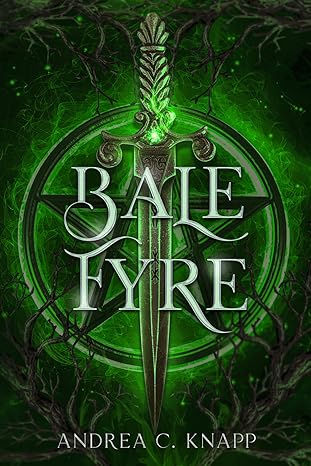
Thanks to Andrea for joining us to discuss Bale Fyre.
You can read more about Andrea and her work HERE.



Comments