


J Leme Thompson - An Interview
- Open Shelf

- Jul 3
- 9 min read
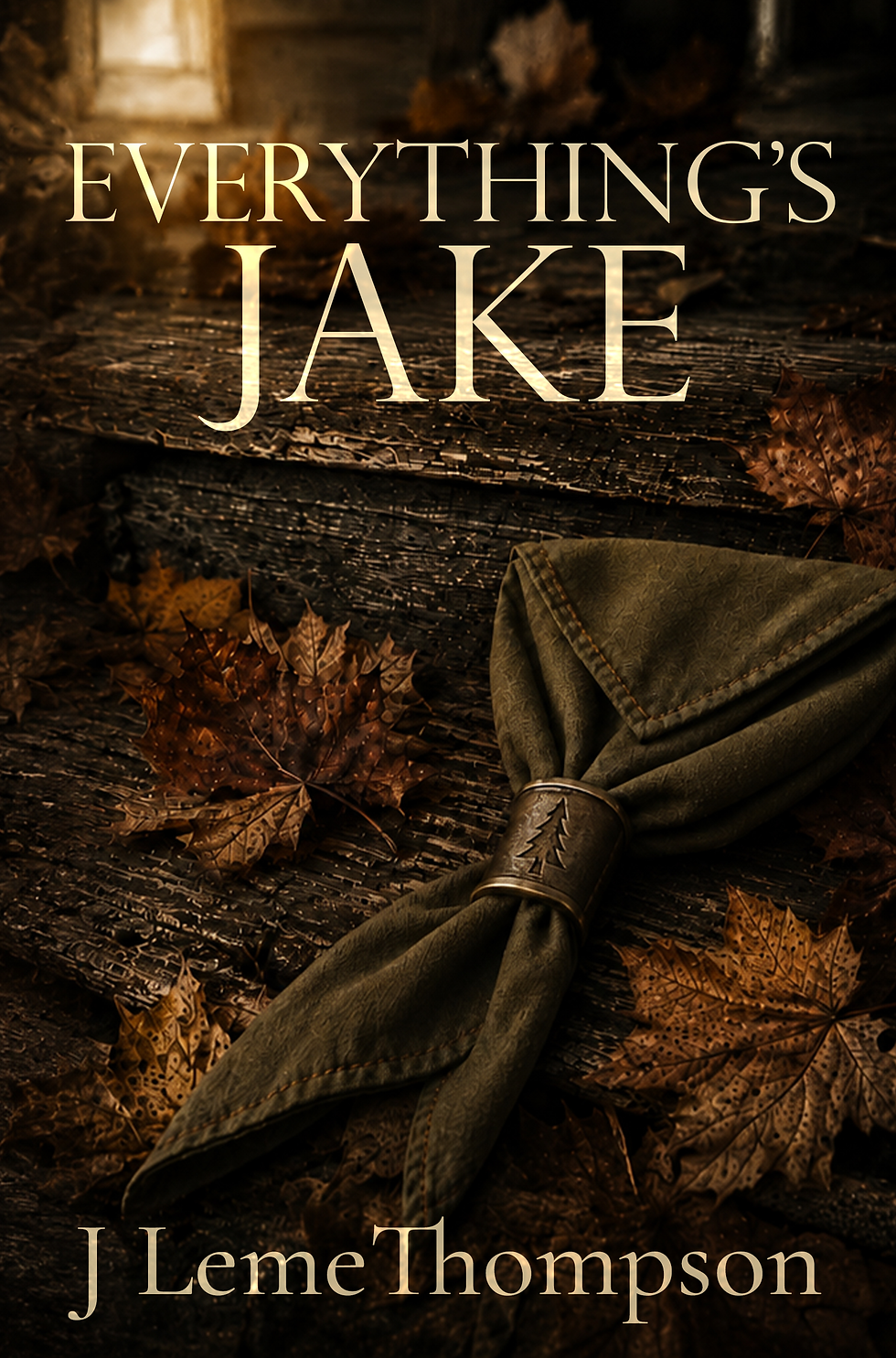
Open Shelf recently read and reviewed the powerful Everything's Jake.
Open Shelf caught up with author J Leme Thompson to find out more.

Let's start by getting right into the story and how you developed its themes. Everything’s Jake is built on silence - what people don’t say, don’t see, or choose not to confront. What drew you to that kind of storytelling?
My entire career was spent in or adjacent to government in central Arkansas. Over the past forty years, I have learned that the public story is rarely the real story. I find the difference between the public and real stories intriguing and frequently maddening.
The novel then handles harm without spectacle. How did you approach writing about abuse in a way that avoids sensationalism?
LOL. Years of therapy? I am a survivor. This story is absolutely fiction, but it is informed by my own story and by the stories of others I knew. I grew up in a small Arkansas town where this type of thing was rampant.
But back to your question. I think learning to speak of my own abuse in actual, everyday language made it much easier to write that way. It isn’t necessary to tell the details of what is happening, and frankly, the reader can likely imagine things much more horrifying than I can write. By no means was that my intention, but it tends to be the case.
The book’s four‑part structure - Roots, Sprouts, Blight, Fallow - mirrors agricultural cycles. When did that structure reveal itself to you?
This novel had been rattling around in my head for at least 25 years, and from the moment that I decided to set the novel on a soybean farm, the “parts” naturally flowed. I grew up around bean, cotton, and rice farms. The seasons or cycles simply felt right.
John’s complicity is quiet, almost invisible to him. What interested you about portraying a character who harms by doing nothing?
I think this is the most interesting question you’ve asked. One of the questions I asked beta readers was, “Are you Team Sarah or Team John?” If this novel were set in the present, John would absolutely be complicit. In the mid-70s, he did exactly what fathers tried to do - take care of his family. Did he do a bad job of it? Hindsight is 20/20, right? The villain in the novel is Tom Reeves. I hurt for John as badly as I hurt for Sarah, maybe more.
Billy’s epilogue is devastating in its restraint. How did you find the emotional balance between honesty and gentleness in his voice?
Oh my, Billy is devastating, isn’t he? I identify with Billy more than any other character because he is a survivor. He is a victim as much as Jake or any of the others. And he must live with what he did. I couldn’t possibly punish him any more than the guilt that he already has.
The Judge Reeves scene is one of the most chilling in the book. What was the challenge of writing institutional corruption that feels polite on the surface?
Because of my career in government, I watched back-room deals for many, many years. I know how they work. There’s a song in Hamilton, The Room Where it Happens - you don’t want to be in that room. Writing that scene was actually one of the easier ones, but with that said, this novel has been rattling around for a very long time. It took retirement and having the time to write it for the book to become a reality.
Rural life in the novel is both tender and suffocating. How do you navigate portraying a place you know intimately without romanticising or condemning it?
I promise you that a soybean farm is not romantic, but I don’t believe that condemning it would be proper. I grew up in it. Was it for me? Absolutely not. Do I have relatives who still live in rural Arkansas and wouldn’t have it any other way? I do. Let’s simply say, “It’s a nice place to visit, but I don’t want to live there.”
Let's have a little for our author readers now. This is a novel that moves slowly, deliberately. How do you think about pacing when the story’s power comes from accumulation rather than action?
This was the hardest part of the novel. How much do you write about something that happens over and over without it feeling like you’ve written about something happening over and over? But you have to, right?
Practically, I wrote the chapters about Jake straight through, then came back and interspersed them with other chapters to help break the tension. I'm not certain I got the balance perfect, but that was the deliberate choice I made to handle an impossible problem.
What was the first image or moment that told you this story needed to be written?
The problem was a big one in my hometown. There was a horrific event that happened 20 years after my own abuse that planted the seed in my head.
And did any character surprise you as the book developed?
Margaret Reeves - and not in a good way. Then again, it is the South in the US, and Tammy Wynette did sing “Stand by Your Man.”
What do you hope readers carry with them after the final line?
Wow. Awareness. I approached the novel like a Greek Tragedy. John’s tragic flaw is his belief that putting his head down and working will save everything. I hope it reads more like a cautionary tale. It really isn’t some pervert on the street corner in a raincoat who is abusing children. It’s an uncle, a pastor, a doctor, someone you trust enough to leave your child alone with them because “they would never do that.” I want readers to understand that the person grooming your child isn't a stranger. It's someone you trust. And that awareness changes everything about how you pay attention.
Let's have a brief look at a couple of your other titles. First, The Durable Physique.

Your approach to fitness rejects extremes in favour of patient, sustainable recomposition. What misconception about fat loss do you most want to dismantle?
Fat loss and weight loss are not be the same thing, and BMI means absolutely nothing as a single statistic. The book is about fat loss while retaining muscle. I’m stronger than I’ve ever been in my life and weigh about the same as I did when I was fifteen years old. I’m still working on those last twenty pounds - slowly, deliberately.
How did your decade‑long transformation shape the philosophy behind The Durable Physique?
Much in the same way that the rest of my writing is shaped. Very few things happen overnight. Whether it’s body recomposition or grooming a family to trust someone with their child, change happens slowly.
Next, let's look at some fiction, and The Cotton Boll Queen.

Annabelle Crump learns to construct herself in environments where beauty, power, and danger blur. What compelled you to explore reinvention through her?
I’m a big “what if?” guy. What if a young girl from the rural south was offered an opportunity to go to the big city? But I don’t think in terms of rags to riches, because those things don’t usually happen in real life. I like to invent a situation that is much more likely to happen and then explore it. The themes underlying The Cotton Boll Queen are not unlike those of Everything’s Jake or The Durable Physique. All three are about power, who has it, and how it is used. I suppose I like to reimagine standard tropes. The Greek Tragedy with Everything’s Jake and rags to riches with The Cotton Boll Queen.
The novel spans Mississippi, New Orleans, Chicago, and Manhattan - each with its own hierarchy. How did place shape Annabelle’s evolution?
Prior to her first visit to New Orleans, Annabelle had never been to a big city, so I wanted her to experience them in size first. New Orleans isn’t big, but it has a big-city feel to it, especially around the Quarter. In all three cities, she is increasingly exposed to the idea that value isn’t value unless it is agreed upon. It’s a supply-and-demand thing (incidentally, my government career was as a real estate appraiser). Salt was hugely valuable from antiquity through the Middle Ages. Today, it’s one of the least expensive things around.
The story examines the cost of being chosen. What does that phrase mean to you in the context of the book?
Annabelle gets chosen, which is what she wants - escape, opportunity, access to a world bigger than rural Mississippi. But being chosen by powerful people means they expect something in return. The cost isn't always money. Sometimes it's your autonomy, or your choices, or pieces of yourself you didn't realize you were giving away. That's what interests me - when you discover how much you’ve paid only after the transaction is already done.
Without probing too much, let's have look at you as an author. Your work explores quiet forms of power - the kind that shape people long before they realise it. Where did that preoccupation begin for you?
I’ve never thought of it as a preoccupation, but I wouldn’t argue the point. I was seven when MLK and RFK were killed. I remember watching the news and, at that age, understanding that some people had power and some didn't, and that power could take lives. Growing up in rural Arkansas afterward, I watched power work at a smaller scale - how certain families, certain men, moved through the world untouched while others bore the consequences. That's what I keep writing about. Not the loud exercise of power, but the quiet infrastructure that lets it work without anyone having to explicitly say 'you can't touch him.' That's where the real control lives.
How has growing up in Arkansas shaped the emotional and moral landscapes of your fiction?
Growing up in Arkansas didn't shape my moral landscape by affirming it - it shaped it by forcing me to reject it. Education gave me the tools to think my way out of that world. My fiction isn't a love letter to the rural south. It's an examination of the systems I had to understand in order to leave. That clarity - seeing how things work beneath the surface - that comes directly from having grown up there.
You write with a measured, classical restraint. Was that a conscious stylistic choice, or something that emerged naturally over time?
It is a conscious choice. I like William Faulkner - especially As I Lay Dying, which shows what you can do with multiple voices and fragmented structure if you trust the reader. I like John Steinbeck, I love Emily Dickinson. She taught me that restraint isn't about withholding - it's about trusting the reader. You give them the pieces and let them assemble the meaning. That's more powerful than spelling it out. I hope to do it half as well as they did.
Now that you live in Lisbon, do you find distance sharpens or softens your view of the American South?
Distance certainly has not softened my view. I can see the patterns more clearly from here - the way systems work, how power operates, what gets protected and what gets sacrificed. From Lisbon, I'm not as emotionally entangled in it as I was while living there. I can examine it more objectively. That clarity probably wouldn't be possible if I still lived there.
Let's have a near to closing look at all your work as one. Your fiction and nonfiction both revolve around discipline - emotional, physical, moral. What connects these seemingly different bodies of work?
There are two ways to move forward in this world - luck and discipline. I'm not that lucky - so everything I write about, whether it's body recomposition or institutional corruption or how abuse accumulates, it's really about discipline. The daily work. The small choices that add up. The refusal to cut corners or look away. That's what connects everything.
Whether writing about bodies or institutions, you return to the idea of slow, deliberate change. Why does that rhythm matter to you?
Things like earthquakes and assassinations happen quickly, but those are the makings of a different kind of novel. What interests me are the tiny inner workings - how Hercule Poirot puts pieces together one by one, how Frodo trudges step by step to Mordor. I'll watch an action movie, but I want to read a detailed novel about how things actually work, how they change, how they break. That's where the real story lives.
Let's finish by returning to the book that brought us to you, Everything's Jake. Which character did you most enjoy spending time with, even if the story itself is heavy?
Jake’s eyes are full of wonder. He’s eleven, but he hasn’t lost that innocence that little kids have. I’ve lived with him a very long time, and it was good to get his part of the novel written. The novel is about John, not Jake, but Jake lives in every sentence in that manuscript.
The novel is full of small, sensory details - leaves, tools, weather, routines. Do you collect those consciously, or do they just show up as you write?
The leaves were there from the beginning. The first and last line of the novel have been in my head since I first thought about the novel. I’ve written the first chapter at least four times over the last 25 years. Weather tends to show up in my fiction. Arkansas gets all four seasons and is prone to tornadoes, so weather is something that I’ve always been conscious of. The other things showed up, but all my work ends up with little motifs. Cotton Boll Queen has moths, cotton, and weather.
If a reader stopped you in a café and said, “I just finished Everything’s Jake,” what’s the first thing you’d hope they’d tell you?
“It made me think.”
And finally…
So, what’s next? Is there a new story in preparation or ready to be released?
I’m writing this on June 2, and The Cotton Boll Queen went live yesterday. Yes, there is another story in the works...
What if…. You were nine years old, and you woke up to find an amnesic leprechaun in the other bed in your room?
Well that's certainly something to ponder!
Thanks to J Leme Thompson for joining us to discuss Everything's Jake and more!
You can read more about the author and his work HERE.


Comments