


C S Queen - An Interview
- Open Shelf

- Jul 2
- 15 min read
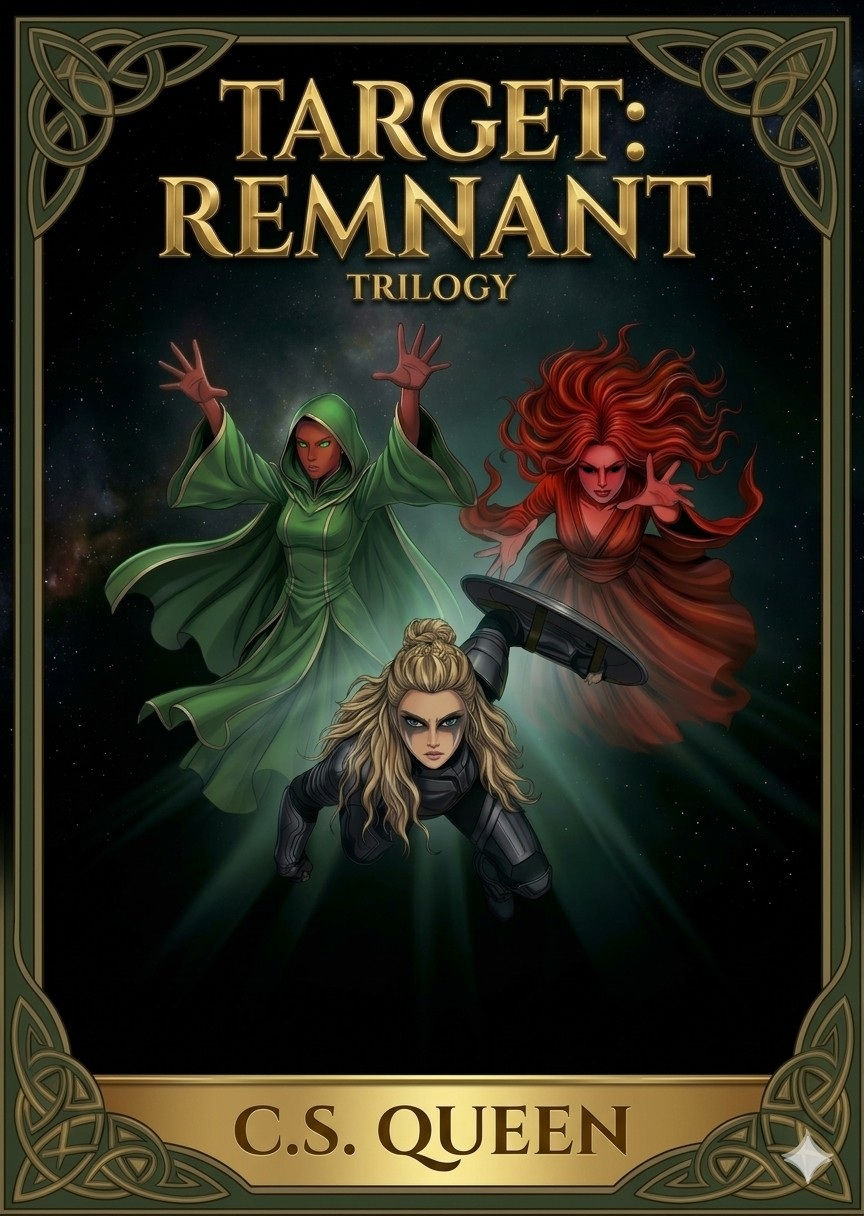
We recently read and reviewed Target: Remnant Trilogy by C S Queen. You can find it HERE.
Open Shelf caught up with author C S Queen to find out more.

What first inspired you to tell a story that spans modern Earth, ancient Britain, and 1960s Chile?
My inspiration is my son! We keep in touch by calling once a week, and we’re usually playing Mario Kart on the Switch while we talk. During our many conversations, we wander into what we call “the what-if realm”. Phrases like, “What if there was a race of adorable aliens who were homicidal?” were common during these times.
When I wrote book I, Orion Team First Contact, it was intended to be a standalone story with a funny twist in the end. I self published it on KDP then moved on to writing other stuff. Later, I kept thinking about Kadis, our Main Character and commander of the Orions. She’s 1,502 years old. She’s half human and half Theronian (aka Remnant). She seems to resent the Remnant, why?
My son and I explored ideas on how something like that happens. What has she experienced in her life? How would her mother spawn a half breed?
We debated about Kadis extensively, then my son said (and I quote verbatim) “Dude! She would have been alive when the Vikings were around.”
Soon, we found ourselves down a rabbit hole, delving into research about life in the UK during that era. That’s when I began writing Refuge Among Humans. The story about Kadis’ mother, Gaelle, who fell in love with a human.
By the time I finished book II, I enjoyed the drama so much, I wanted to write more about the characters in book I.
I wanted to explain why Kadis has a personal vendetta against the Remnant. Again, while my son and I raced in Peach Gardens (game reference), he said “Mom, if they can live for hundreds of years, they’d move all over the world!”
The end result was a story with a historical earthquake in 1960 Chile (a time period between books I and II) that provided me with an opportunity for my character to use her power during a catastrophe.
How did you approach building an alien civilisation that feels both regimented and emotionally complex?
I write my characters to reflect people in my life. I’ve worked various jobs where different careers have their own culture. One thing remains the same across the board, when people are involved, emotions influence the job.
That said, the aliens are no different. I made the Orions and the Kaelen reflect people in the military and law enforcement. These agencies have codes and camaraderie, discipline and structure. But there is the element of humanity. The characters feel frustration, resentment, admiration, loyalty, etc. Those feelings affect judgment and outcome.
On the other hand, the Theronians are portrayed as – sort of – upper class civilians who prefer a relaxed, peaceful lifestyle. This is where beliefs clash, creating the friction that possibly sparked the war between Kaelen and Theron. I added a bigger emotional charge to this when the Theronians become more powerful in Earth’s atmosphere, this hurts the Kaelen pride. I believe pride is relatable to everyone.
There was subtle message I asked myself, then it took on a personality of it’s own. “If I lived for hundreds of years, would I be stoic and wise? Or could my hurts and hang ups turn me into a manipulative monster?” I think the questions add a complexity which shows the world we’ll never be perfect. Not in a hundred lifetimes.
The trilogy blends sci-fi with some fantasy elements. Did you always intend to cross genres, or did the story naturally drift that way?
That’s a great question because I originally aimed for Urban Fantasy. Then the Orions flew in from outer space and now we have a sci-fi story!
I recently saw a funny post on social media which said; I started writing my novel with an outline ready. Then my character started doing something I didn’t like. I argued and fought with my character until I gave up. Now everyone is doing whatever they like and I’m just writing it all down.
I literally had an outline of three ideas I wanted to write. (I don’t want to give the story away) First, YooJin discovers her powers, then Orions come to hunt her, and the twist at the end.
I got halfway through chapter one then someone gets killed. Even I was surprised! So the short answer is “no”, I didn’t intend to go that far into left field. I started writing, the story took on a life of its own and the characters really do whatever they want. I’m just here, documenting things.
Why did you choose to tell this saga through three shorter, tightly focused stories rather than one long novel?
As mentioned, I meant to write one short story. I’d like to add: After publishing Orion Team First Contact, I felt bad when I saw other ebooks then realized how short my book was. People were paying $0.99 for 500 page novels while mine was the same price for 100 pages. This encouraged me to write books II and III (aside from the ideas mentioned earlier), then combined them so readers could get more out of 99 cents.
How did you ensure each story stands alone while still feeding into a larger, interconnected arc?
I’ll start this answer with a strange fact. My husband loves to read history while I prefer fiction. Now that we’ve established that, I’ll tell you why it relates.
I noticed a difference between the books he read and mine. Fiction paints the entire scene needed to follow the adventure, anything that is not mentioned, doesn’t exist. Nobody cares because it wasn’t necessary for the story.
History, biographies and autobiographies tell part of an actual event. There are details that are not mentioned, but they happened. We all have a life story that can be separated into smaller parts which would still be interesting.
I imagined Kadis as a woman with many stories to tell. She’s lived a long time, touched a lot of lives and witnessed much history. For example, Orion Team First Contact is about “the time Kadis went to Earth then found a terrible surprise.”
In Refuge Among Humans, it’s as if Gaelle sat down to tell her daughter about “the day I met your father.”
For Danger Close, Sofia (another woman who is hundreds of years old) tells “about the time she was hunted by Hargorians in Chile.”
What challenges came with writing characters whose stories unfold both before and after one another?
I discovered this the hard way. Consistency is difficult when you have many moving parts! An online forum offered valuable advice warning new authors to be careful when using numbers and time. Because readers will do all the math!
My first draft had precise dates, number of years, city names, street names, how many aliens fought, how many were killed, and how many were left. My details were killing me!
I became frustrated then stopped writing for a long while. My husband got me a book for Christmas by Stephen King called “On Writing”. It really opened my eyes about this issue.
He explained the difference between telling a story and writing directions. Telling a story describes a scene then lets the reader fill in details with their imagination. While directions are strict and precise so there’s no room for imagination. So, Kadis carries a round wooden shield, but I’m not going to tell the reader the exact dimensions of the shield, how many metal studs decorate it or how long the straps are underneath.
I revisited my book, then loosened many details, especially the timeline. Readers get the general idea that Gaelle crashed on Earth in 25 AD. They don’t need to know whether is was on a Tuesday or Saturday.
As the series grows, (I’m finishing book VI at the moment) more characters are introduced, now I keep a flow chart for each alien. This way, when Kadis meets someone in 1960, she knows who they are in 2028. Keeping facts consistent is key because readers will pick it apart if I miss it.
Let's look more closely at a few characters. YooJin’s discovery of her abilities is at times humorous, frightening, and deeply personal. What drew you to her as the trilogy’s starting point?
Every character is a piece of someone in my life. My best friend is a single Korean-American woman living in Seattle, she is the embodiment of YooJin. Her mother is an adorable woman but she constantly worries about my best friend being single in her 40s.
The idea of YooJin came to me while I worked as a funeral arranger in Reno (2022). YooJin’s ex boyfriend has a narcissistic dialogue that reflects real conversations with my ex husband. YooJin’s co-worker, Phoebe, is described exactly like a co-worker I met as a dispatcher (2024). Kenny is a real neighbour that lived next door to me in Nevada, he and his boyfriend taught me how to raise chickens (2018).
The humorous, frightening and personal feeling throughout my books are pulled from reality. Whether it is something that happened to someone I know, or it happened to me, I use the emotion to make my characters feel real.
By the way, YooJin? She was the trilogy’s starting point, as I wrap up book VI, she’s going to bring this series to a close. And it’s going to be dynamic!
Many characters hide parts of themselves - sometimes literally. What interests you about identity as a theme?
I’m impressed that you noticed! There are two reasons I wrote characters this way.
First, I wanted the element of surprise. As I age, I’ve learned no matter how long I’ve known someone, they can reveal something that’ll knock me off my feet. It’s a wonderfully terrifying experience. I hope readers will feel that.
Second, we all hide parts of ourselves in the same manner today. We may not have the ability to bend minds but in a world where social media is the norm, I feel like it equates to the people we meet online. They aren’t all what they appear to be.
Kadurix’s calm acceptance of Gaelle is unusual for a first-contact moment. Why did you choose that reaction instead of fear or hostility?
Yes! Kadurix is a special man and I love him! When I thought about his personality (which I tried to elaborate on paper) I imagined a man who works alone all day with iron. He’s living in a time of druids, his tribe believes in spirits that coexist with people in the forests. The country was heavily influenced by the Roman Empire so the Gauls were familiar with Roman gods. He jokes with Gaelle that he hoped she was a deity of whom he could gain favour by helping her.
I felt this was a time of discovery and change, people were ready for strange and unusual things. Adding his Celtic humour, I went with his calm reaction because a man of his nature doesn’t freak out easy (to put it in modern terms). Besides, Gaelle was beautiful. Even for an alien.
The trilogy repeatedly asks where the line lies between justice and revenge. What sparked your interest in exploring that tension?
This was something I asked myself while working as a law enforcement dispatcher. It comes from watching people act out of anger. When folks called the police, half the time, there was no crime. It was just one person trying to get back at someone else.
I try to challenge readers to feel each character's pain. When you know the whole story behind someone's anger, then our own reaction doesn’t always feel like justice.
How do you balance characters who are powerful enough to reshape events with the emotional vulnerabilities that make them relatable?
Please be patient with me because I don’t want to trigger anyone.
I balance my characters (power and vulnerabilities) because they’re women. Stay with me – I know how it feels to juggle tough jobs, survive an abusive marriage, raise a child then have resilience to give love a second chance.
The part people don’t see, are the times I felt vulnerable. There were many moments I sat alone in a dim room while deafening chaos tormented my mind. The need to be nurtured is relatable, all I did was narrate what people don’t see.
I’m not saying men can’t be strong with vulnerabilities too, but I only have experience as a woman. wink
Several antagonists are driven by duty, pride, or family expectation rather than malice. How important was moral ambiguity to you?
It’s very important to me. It’s also important to me that young readers understand it. Most of the things I regret are things I did because I didn’t step back to evaluate whether it was right or wrong. I simply reacted because of duty, pride or expectations.
I also feel it’s important for young readers to take heed of the repercussions. There’s a reason why we often hear an antagonists say the iconic phrase, “What have I done?”
Each era - modern Korean-American life, Celtic Britain, and 1960s Chile - feels distinct. How did you research and capture those different worlds?
I grew up in a bi-cultural household, my mother is Vietnamese and my father is a Texan of Irish descent. I have several girlfriends who were raised in similar households, I grew up among Korean-American, Filipino-American and Japanese-American families that helped me draw first hand knowledge.
The Celtic fascination comes from my son, he loved Vikings before it was cool to watch on TV. During high school, he completed reports about Celtic cultures, historical battles, and language. I believe he learned some Gaelic for fun.
As we pondered what Kadis would look like while playing Mario Kart, I told him I didn’t want her conformed to the skinny, busty blonde wearing skin tight clothes. My son suggested Kadis be a broad, well-muscled Nordic woman, much like the women he read about.
Chile came about when I was surfing the net, a news article read, “The Historical Quake that Shook Chile”. I didn’t think much of it, then a few days later while building the outline for book III. I needed a catastrophic event where Sofia would use her power but I wanted to try a place other than America or the UK. I remembered the article about that quake. I had to do a lot of research about the cities and events, but half the fun about writing is learning the subject, too.
What made you choose these specific time periods as the trilogy’s anchor points?
It all comes down to Kadis. She started it!
Before we established Kadis as a telekinetic, half alien, she was a Viking woman who never aged. My son indicated this gave us a broad timeline to work with. “Mom, you could literally throw a dart at a map and write a new story for every ten years of her life.” He told me.
As I mentioned previously, the books began with modern America and the rest is history.
How does Earth itself function as a character across the stories?
Depending on which alien we’re talking about, Earth becomes an enemy or an ally.
Earth's affect on Theronians make it a planet where they find sanctuary. Whereas the Kaelen can hardly breath on Earth, which is why the Orions come in as an extension to Byrberslira’s reach.
Without Earth, humans would never come into play. At the end of Orion Team First Contact, Valithian wants to leave Earth because she fears the safety of their friends. In Refuge Among Humans, Gaelle loves Kadurix, then later she gives herself up to protect Kadis. In Danger Close, after the earthquake, Valithian tells Lucas she “tried to stop it” because she was trying to protect the city and the people in it.
Earth’s influence on the characters initiates actions that move the story in places it couldn’t without humans.
YooJin, Gaelle, and Sofia all discover or reveal abilities under pressure. What fascinates you about characters learning what they’re capable of?
It fascinates me that pressure shapes true character.
I feel women in general are strong, but become stronger as mothers. Motherhood gave me the strength to accomplish things I never thought possible. The detail of discovering strength under pressure was my nod to motherhood.
On a broader spectrum, I believe that people do their best when things are at their worst.
How did you decide the rules - or deliberate lack of rules - governing these powers?
It occurred to me during another conversation with my son (perhaps he should be part of this interview) when we came up with DeadZone (our red-headed neutralizer with the deadpan humour). My son explained a concept from Dragonball where each character's ability was quantified into numbers, and anyone who had a higher number could shrug off other abilities. As the series progressed, he felt the number thing became ridiculous.
So I tried to balance each ability with limitations based on what would challenge each character.
The alien factions each have unique strengths and weaknesses. What guided the design of those differences?
I’m not certain if you mean the design of each species or the groups that battle each other, so I’ll answer both!
In regards to creating each alien; The world around me provided the tools which fed my imagination. Alligators are larger than eels but they're in for a surprise when they get electrocuted. Humans can build weapons of mass destruction but a virus could lay us out for days. My dog outweighs my cat by 60 lbs (27 kg) but she’s terrified of the cat.
The aliens in my book have superpowers like the animal kingdom, they just work a little differently.
As for the groups like the Kaelen, Theronians, Orions and Hargorians; I got those ideas from modern military Intelligence. I know! Sounds strange, but hear me out.
When I was an Intel Analyst, we studied air power and defences of other countries intensively. For every plane, there were anti-aircraft missiles. For every missile, there were countermeasures like flares or chaff. For radars, there are jammers. And so on.
Everyone has countermeasures for the enemies arsenal. If one country came up with something, another country would expand on it. “Adapt and overcome!”
I compared each faction to various countries of our world then tried to keep it true to modern warfare.
The trilogy maintains a light, humorous touch even in moments of danger. How do you strike that balance?
It comes from high stress jobs which take on a strange kind of humour in order to deal with each situation. Some see it as blowing off steam, some leaders told me they used humour to keep their troops calm. It was a way to stay grounded.
I threw humour into tense situations to show the reader that we can still smile if we’re dying.
Dialogue plays a big role in defining character relationships. How do you craft conversations that feel natural across such different cultures and eras?
I grew up a US Navy brat, which taught me to adapt in different cultures because each country not only speak differently, but their society have different norms. I also grew up with some old fashioned parents, I realised how they were affected by the events of their generation.
While I wrote about life in 25 AD, I considered a country heavily influenced by the Roman Empire. I also had to be careful about using words that didn’t exist in the era, like using “mead” or “ale” instead of “beer”.
As I wrote about life in 1960, I tried to paint a subtle picture of an unmarried woman discreetly having a love affair with an unmarried man, albeit they were in their 50’s, but what would the neighbours think? I enjoyed looking through historical pictures of Chile in the 60’s, I began to get a feel of their life by the style of women’s hair, the classy shirts men wore and the proud smiles.
Full immersion works well for the imagination, so I used many references to put myself inside their world.
The pacing is brisk, but the emotional moments land strongly. What’s your approach to writing short-form fiction with depth?
That worried me at first because I tend to ramble, the stories started out as anything but brisk. It was very cluttered. When I brain dumped the story in the first draft, I wrote down everything without reservation. Then I returned later to carve much of it out.
As for the depth; In the book “On Writing”, Stephen King suggests watching your ideal reader as they read your story, when they put the book down to pause or take a break. Find out which part they stopped at, then make that part irresistible. The goal is to keep a reader flipping the pages so they never want to put the book down.
Now, I’m not saying my book is Stephen King material, but I want to give readers something they can’t pull away from.
Did you always know how the three stories would converge, or did the ending evolve as you wrote?
I’ve pretty much answered this but the question you should be asking is; Do I know how books IV, V and VI will converge or will the ending evolve?
The answer is “no”. I have no idea what my characters have planned. But I will tell you a little secret… My son recently asked, “What if Kadis had a daughter?”
Which character surprised you the most as the trilogy developed?
Valithian Therona! She starts as a secondary character in book I, although she’s not mentioned in book II, she takes on a completely different vibe in book III. I meant for her to be an ominous character (hence the solid black eyes) to pit against Byrberslira. But then she becomes this sweet, older Chilean woman who finds love late in life.
Things seem to go well with this man until his unfortunate demise turns her motive into (gasp!) justice or revenge. Now she’s had this meaningful side come out with a hint of ruthlessness, I like her more every time I write about her.
If you were to expand the universe, which era or character would you return to first?
Definitely 25 AD. I get it! That era was not easy, but I want those simple times without technology. I’d live on that countryside with my husband and raise chickens, sell eggs then write stories about the future.
The things I would write will blow their minds then 2,000 years later, people would marvel at the things I knew!
We were actually meaning as part of the fiction, but we now know for sure where your heart lies!
As we come to a close, what do you hope readers carry with them after finishing the trilogy?
Part of this answer is written in my dedications;
“To my Husband. You gave me courage.”, “To Sammy. When you don’t fit in anywhere, make your own place.”, and “To those who have been betrayed, anger is cancer. Don’t let it fester.”
This comes from my heart.
As a teenager, I felt lonely and unloved, I turned to books escape my pain. The stories taught me many things like being courageous, true to myself and letting petty things go.
I hope a young reader carries this with them through the pains of my characters.
If you could ask readers one question about their own sense of justice, identity, or belonging after reading, what would it be?
My question to them would be; “Is it better to be right, or be at peace?”
Thanks to C S Queen for joining us to discuss Target: Remnant Trilogy and more!
You can read more about C S Queen and her work HERE.


Comments