


Eric Solomont - An Interview

We caught up with Eric Solomont, author of the excellent The Quiet Part. During the interview his wife adds some insight too - it's ES for Eric, and AS for Alicia.

Your bio mentions that you write character‑driven fiction exploring moral tension and restraint. What draws you to those quieter, internal conflicts rather than big, external ones?
ES: The event that changed my cognitive life also changed my emotional one. Before it, I was extremely logical, mathematical, and self‑contained. I think I did plenty of good in the world, but I didn’t feel much for other people. My own mind was the centre of everything.
Afterward, that shifted dramatically. I lost the ability to rely on logic or math, and I became far more emotionally attuned. My empathy, which had once been almost non-existent, became a defining part of who I am. I also became highly sensitive to sensory overload, which made loud, chaotic environments difficult to tolerate
All of that drew me toward the quieter tensions people carry. I became drawn to the conflicts that live beneath the surface, the ones shaped by restraint, silence, and the choices people make when no one is watching. External conflict can be loud, but internal conflict reveals character. The moral weight of what goes unsaid can hit just as hard as any dramatic confrontation.
Those subtle pressures feel more honest to me. They invite the reader to lean in. And when a story is built on that kind of quiet intensity, the moments of true rupture, the harsh motives and sudden reactions, land with far more force, without needing spectacle.
AS: Eric has never been someone who “lives on the outside of his skin,” and Joseph Henry reflects that. He has always been an inward‑looking soul. He lives by his convictions and is the most honourable, upright, and authentic person I’ve ever met. Knowing how he thinks and moves through the world, it’s no surprise to me that his first book’s main character is also a man of principle, who strives to stick to his own moral compass and struggles with those who do not.
You’ve already mentioned, and previously spoken openly about, writing with a memory disorder. How has that shaped your creative process, and in what ways has it influenced the structure or tone of The Quiet Part?
ES: My memory disorder affects me in ways that are both immediate and long‑term. I can lose details from one day to the next, and sometimes even in the middle of a thought. If my attention is pulled away, the thread can vanish instantly. Over longer stretches, days, weeks, entire pieces of information simply fall away. Even reading a novel becomes an exercise in stitching together short stories; sometimes I can reconstruct the whole, sometimes I can’t.
When I read a book, I have gotten in the habit of treating it like I’m reading short stories. Sometimes I am able to stitch them together and get the gist of the over-all story, other times I can’t. This is less of an issue with older books that I had read prior to the event.
That reality shapes my writing in profound ways. I work in very compartmentalized pieces, and I have to finish a section before moving on, because the intention behind it may disappear if I leave it unfinished. Sometimes I return to a fragment and can pick up the thread; other times I have to start over because the original ideas is gone entirely.
There have been mornings when I woke up planning to write a scene, only to discover I had already written it. I’ll read it and think, Well… that’s not bad. And then there are the “phantom memories,” when I’m certain I wrote something, but I go in to continue and find it never existed on the page at all.
Because I don’t always remember the origin of a scene or why I chose a particular detail, revision becomes an act of discovery. I often read my own work the way a new reader would, without attachment, without ego, and without the usual writer’s defensiveness. I think that distance helped shape The Quiet Part. It allowed me to revise without clinging to what I thought I had intended, and without taking it personally when a passage needed to be cut or reshaped. The work never felt too precious to change.
So, I guess the process was shaped quite literally by the capabilities and tools that I am left with.
AS: Seven years ago, our world was turned upside down when Eric woke up and said, “Something isn’t right.” Where he was once logical, analytical, and emotionally distant, he became expressive, intuitive, and empathetic. Now he can forget conversations, tasks, or plans from one moment to the next. He truly lives in the present and has to fight to recapture anything beyond it.
Because of that, every concept, character, and chapter had to be created separately. He couldn’t refer back to what he’d done the day before… or even an hour before. His only option was to write whatever was in his mind that day and later figure out where it belonged in the larger story.
Many writers rely on continuity notes or outlines. With your unique process, how do you keep track of emotional arcs or character evolution across drafts?
ES: Because I write in what are essentially self‑contained “short stories,” I can’t rely on carrying emotional continuity from one section to the next. I simply won’t remember what I was trying to evoke, or how. So instead of tracking emotion across an outline, I make very deliberate decisions at the start of each piece: What do I want the characters to feel here? What do I want the reader to feel? What emotional temperature should this scene hold from beginning to end?
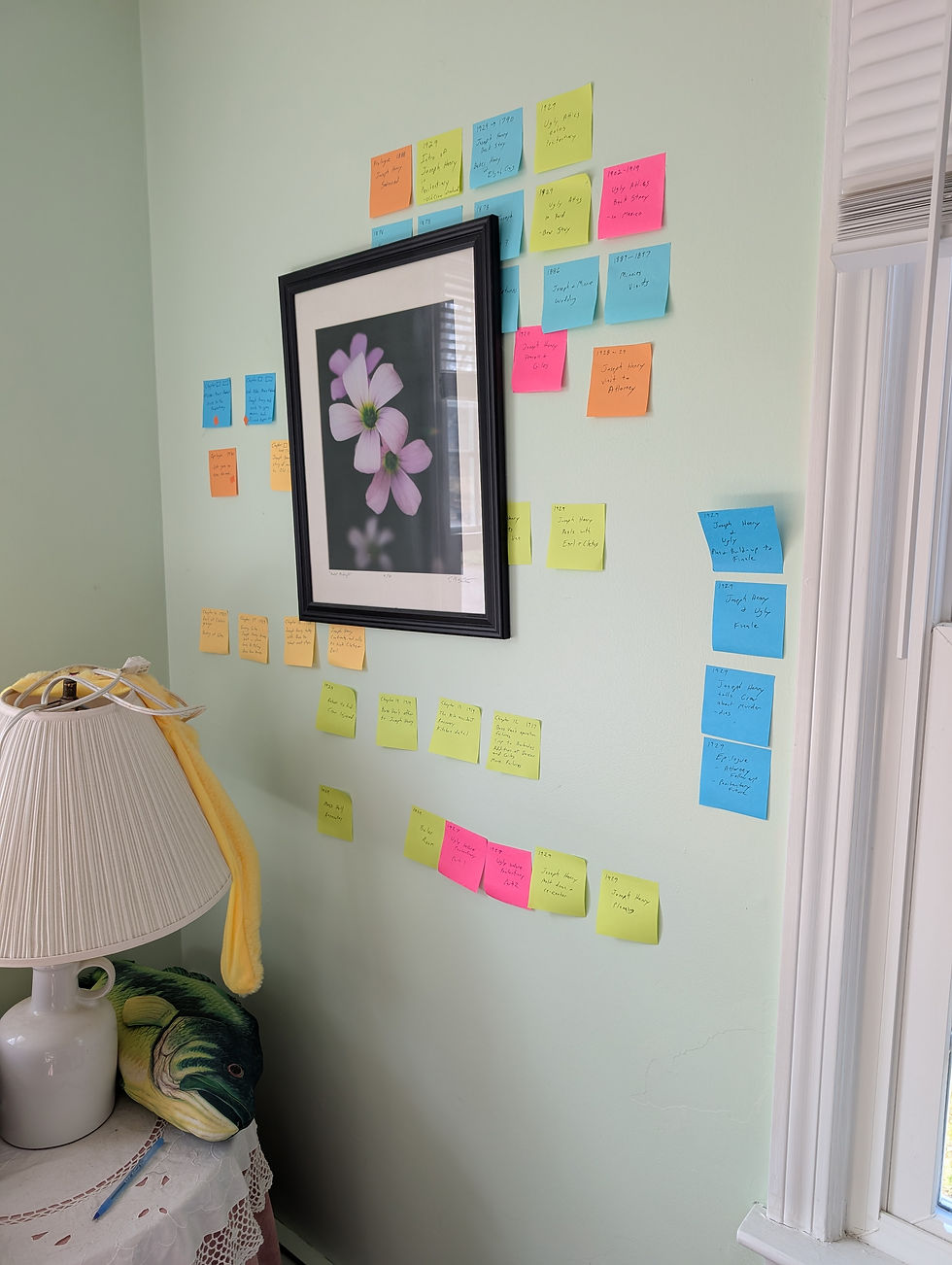
I do keep a loose outline of major milestones, and I use Post‑it notes on the wall to track where scenes, chapters, and arcs belong. But the emotional arc of each piece has to be built in the moment, with full intention, because once I move on, the internal thought process behind it is gone.
A good example, without giving anything away, is Minnie’s return. Like most cases, that chapter was its own short story. Before I wrote a word, I decided exactly how Joseph Henry would feel, how Minnie would feel, and how I wanted the reader to feel. I wanted that chapter to have a distinctly Capraesque warmth, something no other chapter in the book carries. Maybe the wedding comes close, but even that has a different emotional texture.
If readers look closely, they’ll notice that many chapters, or clusters of chapters, each have their own emotional signature. That wasn’t a grand structural plan so much as a natural result of how I write. When I finish a piece, the emotional intention behind it disappears from my memory, so each new section has its own fully realized emotional state.
AS: Because each chapter emerged as its own compartment, Eric had to invent a system to track what he’d written and what he thought he’d written but hadn’t. He sorted chapters into categories like year and focus character, summarized each one, and assigned each category a different color of Post‑it note. Then he covered a wall with them and rearranged everything until they made sense.
Do you feel your memory disorder gives you a different relationship to your own work?
ES: Yes, my disorder absolutely gives me a different relationship to my work. For me, FND (Functional Neurological Disorder), affects both memory and focus, and one of the abilities I lost is the ability to multitask. If my attention slips, even briefly, the entire thread of what I’m doing can disappear. As a coping mechanism, I often focus intensely on one thing to the exclusion of everything else.
In my writing, that means I will become completely immersed in a single character or plot point. In the moment, I develop a deep attachment to whatever I’m working on, sometimes to the point of tunnel vision. It’s something I have to watch carefully so I don’t disappear down a rabbit hole, but it also allows me to inhabit a character’s mind with unusual clarity.
For example, when I’m writing a chapter where Ugly is the point‑of‑view character, I just can’t hate him. I’m too far inside his head. But when I’m writing from Joseph Henry’s perspective and Ugly enters the scene, I feel Joseph Henry’s loathing as if it were my own. My emotional alignment shifts completely depending on whose consciousness I’m inhabiting.
Once a piece is written and I return to it later, the emotional and narrative connections are often completely gone. I then experience my own work with a kind of distance, sometimes as though someone else wrote it. That can be disorienting, but it can also freeing. It lets me read and edit without ego, without defensiveness, and sometimes with genuine surprise. I often discover layers I may not have consciously built.
AS: There are many times when Eric reads something he wrote and it’s completely unfamiliar to him. He’ll sit down planning to write a scene and discover pages he already wrote on that exact topic. Other times, he’s certain he wrote something, only to find no trace of it. It makes shaping a storyline incredibly difficult, like building a sandcastle while the tide keeps washing it away. If he’s lucky, a faint outline remains to guide him.
What first inspired you to write fiction, and when did you know The Quiet Part was the story you wanted to tell?
ES: I’ve always written in some form. Before the event that changed my cognitive life, I studied English, writing and literature, at university (In US we’d say English major in college), but I rarely finished anything. I was so logical and analytical that I’d get tangled in the weeds of description and never move beyond it. I did win a contest once for submitting a specific Doctor Who episode pitch. I won a two‑foot‑tall remote‑control Dalek. But fiction never fully opened for me then. I couldn’t feel it.
After the event, everything shifted. Logic and math disappeared, and in their place came a kind of artistic creativity I’d never had before. I went from not being able to draw a straight line to drawing and painting. Music, which I once appreciated only as pattern, suddenly hit me emotionally. And writing changed completely. Instead of building a grid of descriptive sentences, I could feel what I was writing, the characters, the atmosphere, the emotion.
As for The Quiet Part, I honestly can’t remember when or how it began. That memory is gone. I remember fragments, and I can guess at some of it. My love of whiskey, it may have begun with that. I remember the Deacon and Giles characters, and thinking about the contrast between the American South and Barbados at the turn of the century. I remember imagining the world and the era, and then writing “short stories” inside that box. Each time I wrote a piece, I dove into research to make sure the details held up. No doubt a carry over from my earlier, more analytical self.
AS: Eric has been writing bits and pieces since high school, but he often abandoned projects before finishing them. The Quiet Part had been brewing for two or three years, slowly gaining momentum as his bandwidth shifted and he found tools that helped him capture, fact‑check, and organize his work. Those tools were key to sustaining his enthusiasm.
Looking closer at the book…
Joseph Henry is such a restrained, quietly powerful character. What was the first spark that brought him to life for you?
ES: You know, this question actually makes me recall something. I think the very first “short story” I wrote, the one that would eventually grow into The Quiet Part, was the Baker Henry piece. I’d been thinking about the old Elijah Craig legend, the story that he invented bourbon after a fire charred the inside of his barrels and he used them anyway. The whiskey that came out of those burnt casks had the deep colour and character we now associate with bourbon.
I decided to twist that myth. In my version, Baker Henry caused the fire, and Elijah Craig took credit for the outcome. From there, I imagined Baker learning whiskey‑making alongside Craig, but only one of them becoming famous. The other lived a quieter life, passing the craft down through generations until it reached Joseph Henry.
Beyond that, I honestly don’t remember how Joseph Henry himself emerged. That part is gone. So what I’ll offer is a story that at least sounds plausible. I imagine I started with Joseph Henry as a steady, capable, respectable young man with three generations of whiskey‑making behind him. Interesting, but not enough on its own. So I put him in a penitentiary. It’s Prohibition, the warden is running an illicit whiskey operation that isn’t going well, and suddenly he realizes the man who could fix everything for him has been right under his roof the whole time.
I can’t say with any certainty that this is how Joseph Henry came into being. But given the pieces I do remember, and the way I tend to build stories, it’s as good a story as any. And it feels true to the spirit of how he may have arrived on the page.
AS: To me, Joseph Henry’s ethics strongly parallel Eric’s. They both stand by their morals, look for opportunities to help others, and are “good men” whose first instinct is often to turn the other cheek. Since the brain event, Eric’s shift from emotionally distant to deeply empathetic may have brought more of those qualities to the surface, and into Joseph Henry.
The novel blends psychological tension with historical detail. How did you approach researching Prohibition‑era Kentucky and the prison system of that time?
ES: Most of my research was done online, and I’m perfectly comfortable saying that. With my condition, I can’t retain large amounts of information over long stretches, so I research in focused bursts, diving deep into a specific detail, confirming it, and then writing the scene while it’s still fresh. I took a lot of notes along the way, which helps me reconstruct the context here.
For the penitentiary, I wanted a real, lived‑in location from the era. I looked at several historical prisons, and while the Frankfort Penitentiary in the book is an amalgamation, the real Frankfort Penitentiary reflected about seventy‑five percent of what I wanted, including the fact that it burned down years later. From there, I searched historical records and even some fictional accounts to understand the smaller details: what the washroom would have looked like, how the yard was used, what the mess hall felt like. I researched work details too, everything from the easy assignments to the ones that would “take years off a man’s sentence just by taking the years off the man.”
Because of my limitations, I researched only what I needed when I needed it. For example, I found good information on turpentine harvesting early on, but I didn’t dive into the specifics until I reached the chapter where it mattered
Sometimes the research even surprised people around me. A friend texted me recently, “Vinegar pie. WTF 😕” after reading the wedding chapter. I had done extensive research on what the women of that era and region would have made for a celebration, and vinegar pie came up again and again. I even tried the recipe myself.
In the end, I think I enjoyed the research as much as the writing.
There are many real locations and people in The Quiet Part, or at least locations closely based on real ones; the H‑B Creamery, Eli Sparks’s place near Perryville, and even Ed Levinson out of Detroit.
AS: The resources available physically and online were crucial. Eric spent a tremendous amount of time digging into details, large and small. He has always had a thirst for learning, and his interests are broad and diverse. I’ve always called him a Renaissance man; he can discuss virtually any subject.
The book explores loyalty, buried truths, and the choices that shape a life. Which of these themes emerged first, and which surprised you as the story developed?
ES: This is a tough one for me, because I don’t write toward explicit themes. I never sit down and say, “This book is about X.” I write the characters and the situations, and the themes surface on their own. Some of them I only recognize much later.
If I had to choose one that genuinely surprised me, it was the parallel between the protagonist and the antagonist. Joseph Henry and Ugly are very different men, but they share a similar internal architecture. Both are restrained in their own ways, both carry a quiet volatility that can either steady them or undo them. I didn’t plan that. It revealed itself as I wrote, and once I saw it, I realized how much it shaped the tension between them.
The prison setting feels incredibly authentic, lived‑in, human, and textured. How did you balance realism with the emotional weight of Joseph Henry’s inner world?
ES: I don’t think balancing realism with Joseph Henry’s emotional world was something I approached consciously. I don’t outline emotional arcs, and I don’t write toward themes. What I do, as I mentioned before, is immerse myself completely in the character I’m writing in that moment. When I was writing Joseph Henry, I felt what he felt, or maybe he felt what I felt. His restraint, his quietness, his sense of duty, his longing, that became the lens through which I saw everything around him.
The realism may come from the research and the sensory details. I spent a lot of time looking at photographs, reading accounts of prison life, studying the work details, the food, the routines, even the architecture. Those concrete details gave me the physical world Joseph Henry had to move through.
I think the balance happened naturally. The research grounded the setting, and the character’s consciousness grounded the emotion. I wasn’t trying to make the book more realistic or more emotional; I was just trying to be honest to the moment I was writing in. When the two things met, that’s where the story found its shape.
Without giving spoilers, the novel slowly reveals layers of Joseph Henry’s past. How did you decide what to reveal, and when?
ES: I’m not certain I ever sat down and consciously decided what to reveal and when. The book wasn’t built that way. I’m not sure I could have built the book that way. Most of what readers experience as “reveals” were simply the short stories themselves, each one opening a window into a different moment. It may seem like reveals, because some of the short stories, or arcs, had to be broken up and spread out.
The only true “big reveal” was why Joseph Henry was in the penitentiary. I knew that had to come late, and in a way that felt earned. Along the way, I did reveal the different sides of him, but those moments came more from opportunity than design, when a scene allowed me to show a facet of him, I did.
The Harland Letcher section, in the part about Joseph Henry and Minnie’s youth, was always meant to be obvious. But most readers assumed that was the event that landed Joseph Henry in prison. I can’t tell you how many times someone asked, “When do we find out what happened to Harland Letcher.” I never had the heart to say, “We don’t.”
As for the real reveal, why Joseph Henry was in, my notes show that he was always meant to tell Old Crow near the end, at a moment when he couldn’t repeat it. I also made the decision to write that final flashback in first person. A lot of friends warned me not to do that; a sudden switch to first person that late in a book can be the kiss of death. I didn’t care. It felt right for that moment, and I think it works.
In the end, the reveals weren’t really engineered. They emerged in the same way the story did, piece by piece.
Personally I think a switch to first person can really bring in a sharp focus.
The whiskey operation, the shifting loyalties, the old murder, these threads intertwine beautifully. Did you plan that structure from the start, or did it evolve organically?
ES: This question really goes along with the last one. As I said, there weren’t any purposeful “reveals” so much as the short stories themselves. I suppose those were the intertwined threads. When I wrote them, they were truly standalone pieces. When I finished one, I’d set it aside and move on to the next. Sequentially, the next story might have happened immediately after, or decades earlier, or with entirely different characters. I don’t even remember writing some of them.
Later, I went back through everything, put each piece on a sticky note, and stuck them on the wall. Then I moved them around until the order felt right. Those became the jumps forward and back in time. Originally, I thought the timeline would be more evenly spaced, but once the notes were on the wall, the numbers in each period didn’t add up. So I ended up with a jump from 1929 to 1889, then to 1917, and so on.
I was worried it might be disorienting, or not grounded enough in 1929. My wife told me it worked fine, so there you are.
And I can be a bit lazy, so I don’t mind telling you: the sticky notes are still on the wall even though I put the picture back up that was there before.

Were there any particular inspirations for the story?
ES: I can’t point to any specific inspirations, at least not ones I can remember. I do remember wanting the chapter where Joseph Henry and Minnie reunite to feel a bit Capraesque, that warm, earnest emotional tone you get in Frank Capra’s films. It’s possible I had similar touchstones in mind for other parts of the book, but if I did, they’re gone now.
A couple of people have asked whether I was inspired by The Shawshank Redemption, or the novella Rita Hayworth and Shawshank Redemption. That’s a definite no. I liked the movie, and I loved the book, but I don’t think there are many similarities in narrative or theme.
So if there were inspirations, they may have been more atmospheric than direct.
AS: One of Eric’s passions is whiskey, and he’s always been curious about how things are made. When you combine fact with history and something he enjoys, you get the backbone of The Quiet Part. He had known the Elijah Craig origin story, and it stuck with him enough that he wanted to include it.
The method…
Your prose is subtle and sensory, right from the prologue. How do you approach writing scenes that are quiet but emotionally charged?
ES: I’m not sure I approach it in a deliberate way. Before my cognitive changes, I couldn’t write this way at all. Everything I did was structured and analytical, and it never carried any emotional weight. Afterward, that shifted significantly. I became much more sensitive to emotion and to sensory input. Loud or chaotic environments became difficult for me, and I think that pushed me toward quieter spaces, both in life and on the page.
When I write, I’m not trying to heighten a scene. I’m usually doing the opposite. I focus on a few specific details, what someone notices, what they choose to say or not say, and I let the rest sit beneath it. I think the emotional weight comes from what isn’t fully expressed or present. If I explain too much, it disappears. So I try to stay close to the surface of the moment and trust that what’s underneath will come through.
I try to make nothing gratuitous. Today, everything is gratuitous. Nothing is subtle. Because of this, I did wonder whether readers would be disappointed in the antagonist’s outcome, whether he got his “comeuppance”. In the end, I don’t particularly care. I think the world can handle more subtlety.
AS: Since “the change,” Eric’s world has become full of emotion and sensory input, sometimes overwhelmingly so. His natural demeanor is quiet and introspective, and I think his prose reflects a blend of who he was and who he has become.
Joseph Henry is both steady and deeply vulnerable. What was the most challenging aspect of writing a character who reveals so much through restraint?
ES: I don’t think restraint itself was the challenge. As I said, that’s where I tend to write from now.
If anything, the difficulty was maintaining that restraint without letting the character feel distant or static. When someone doesn’t openly express what they’re feeling, there’s always the risk that the reader won’t feel it either.
So the focus became making sure that what Joseph Henry does, the choices he makes, the things he avoids, carries enough weight on their own. The reader should sense what’s beneath the surface without it being spelled out.
I do occasionally slip into an explanatory voice. I joined a writer’s group for a while, and every so often someone would throw out the old “show, don’t tell” adage. I studied English literature and writing; I’ve heard that for decades. But when I’m writing, I think I know what I want to say, so I say it. And when I’m editing and I come across those “tells,” I sometimes feel they actually add to the restraint. I may not remember writing them, but they feel natural for the character.
AS: Again, I see Eric’s own characteristics coming through. He struggles with the tension between who he was and who he is now, and that tension shows up in Joseph Henry’s restraint and vulnerability.
The novel’s pacing is deliberate, confident, and immersive. How do you think about rhythm when writing, especially given your unique drafting process?
ES: I don’t think about rhythm in a technical or deliberate way. My drafting process is so fragmented, writing short isolated pieces, that pacing isn’t engineered or even thought about the way some writers seem. What I think I do instead is stay very close to the emotional temperature of the moment I’m writing. Each scene has its own breath, and I try to honour that.
I usually have the rhythm and pacing of the scene in mind when I sit down to write. Sometimes I’ll reread the surrounding scenes or chapters and decide whether I need to match them. More often, I just write based on what I decide for that session. I’m aware that the pieces might not always match the surrounding parts or even the overall narration, but none of my readers brought it up as an issue. When I reread, I can feel differences between scenes and chapters, but nothing that makes me cringe.
I think I’ve said before that because I write in bursts or chunks, I encounter my own work almost as a new reader. When I come back to a piece, I can sometimes feel whether it’s moving too fast, lingering too long, or landing in the wrong emotional register. That “fresh eyes effect” became a big part of my editing process, and it probably helped me shape the rhythm without fully thinking about it.
The quietness of the book plays a role too. I’m sensitive to noise and chaos in the real world now, so I naturally gravitate toward slower, more deliberate scenes. In a way, my writing has become a built-in therapy for me. And when I stack enough of those moments together, a rhythm naturally emerges. Not planned, but consistent.
Flashbacks can be tricky to integrate. How did you ensure they strengthened the narrative rather than interrupting it?
ES: I never really thought of the shifts in time as flashbacks in the traditional sense. The book was built from short, standalone pieces or stories, and many of those just happened to take place at different times. Because of that, they didn’t feel like interruptions to me, they were just different stories.
When I later put everything on the wall and started arranging them, I paid attention to how the different parts sat next to each other. I was concerned about having too many sections in a row that moved away from the 1929 timeline. I found that I had more of those scenes than I had initially planned. I spent hours moving the pieces around, sometimes to the point of not remembering what some of them were. My wife was a good sounding board. In a lot of ways, she has helped supplement for a missing part of my memory.
But, because the parts were written as separate short stories, those pieces weren’t meant to explain the plot so much as reveal characters or details. They weren’t there to answer questions; they were there to give the reader another angle on Joseph Henry, Minnie, or the world they were in. I think this strengthened the narrative without getting bogged down in the shifts in time.
AS: During the Post‑it Note process, Eric worried constantly about where the crucial flashbacks belonged. He wrote, rewrote, and shifted those notes dozens of times until they clarified rather than confused. Each flashback had a purpose—revealing vital pieces of the characters and offering insight that needed to be woven in.
What do you hope readers carry with them after finishing The Quiet Part?
ES: I don’t think I’d want to tell a reader what they should take from it.
If anything, I hope they come away with a sense that people are rarely as simple as they appear. That what someone shows the world and what they are capable of aren’t always the same thing.
And that the choices a person makes quietly, the things they hold back, can shape a life just as much as anything done in the open.
If there’s anything more personal in it for me, it’s the idea that change doesn’t have to mean limitation. My own experience forced me to approach the world differently, and in some ways, it opened doors I didn’t know were there. If a reader takes anything like that from the book, even indirectly, that would mean a great deal to me.
AS: Eric would probably never admit it, but I’m sure he hopes readers take away both hope and strength—that standing by your morals and convictions, and supporting the people you care about, will lead to a better ending.
The Future...
Has writing this novel changed how you think about your next project? Are you drawn to continue exploring historical settings, or do you see yourself shifting genres?
ES: I wasn’t giving much thought to my next project as I finished The Quiet Part. When I completed it, I had no intention of going straight into another book.
My wife was my biggest fan and supporter during the process, but this type of historical fiction wasn’t exactly her thing. So after finishing The Quiet Part, I decided to try writing something in her genre, which is fantasy. I’m about 30,000 words into it at this point, and I’m enjoying it much more than I expected.
The scope and world-building are entirely different, but my writing process hasn’t really changed.
AS: He’s already started his next project, and it’s a doozy. His process hasn’t changed. He still writes one chapter or scene at a time as inspiration hits, often forgetting what he’s written or where he intended to go. Ideas come to him daily, but interruptions can make them vanish. Regarding genre, he’s shifted to fantasy as an homage to his constantly available beta reader: me.
Finally, what advice would you give writers who feel their own limitations, physical, cognitive, or otherwise, might hold them back creatively?
ES: I would start by being careful with the word “limitations.” I understand why it’s used, but it can sometimes become a label that defines what someone believes they’re capable of, rather than something they learn to work with.
People have different abilities, skills, and talents. That’s true for everyone, whether it comes from a physical or cognitive challenge, or simply from how someone is wired. The important part is figuring out how to move forward with what you do have, rather than focusing on what you don’t.
I think the advice would be to not let something that’s been named about you decide what you can or can’t do. Work with what you have. In some cases, it may not just define your process, it may define what makes your work your own.
AS: I think Eric would say: “Accept who you are, don’t obsess on who you were, and never, ever give up.”
Thanks to Eric (and Alicia) for joining us to discuss The Quiet Part.
You can read more about Eric HERE.
And if you want to see our review of The Quiet Part check HERE.



Great answers